


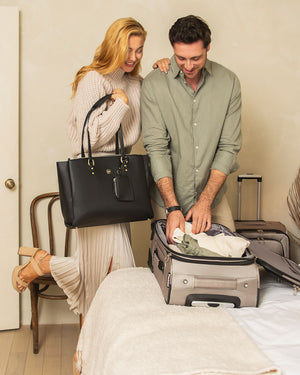

Before a single zipper is chosen or a pocket is added, every SWISSGEAR backpack starts with one question: Who is this bag for?
That's where Sebastian, a product designer at SWISSGEAR, begins every project. Before choosing materials or sketching layouts, he's thinking about the person carrying the bag and how it will fit into their everyday life.
As part of the team designing backpacks for one of the industry's most recognizable brands, Sebastian balances decades of travel expertise with changing consumer expectations.
"I think the first thing we have to consider is the use case," Sebastian says. "A travel backpack is going to be very different from a school backpack or a professional backpack. Identifying the intended purpose is generally the first thing we need to establish: what's going to be the key feature of this bag?"
It's a simple question, but it shapes every design decision that follows.
How Backpack Design Starts at SWISSGEAR
Many people assume backpack design starts with capacity or material selection. It doesn't. It starts with a scenario: Where is this person going, and what are they carrying to get there?
A 17-liter backpack and a 32-liter backpack may share the same name, but they're designed for completely different experiences.
"The 32-liter is probably more travel-focused," Sebastian explains. "Maybe even hiking. Smaller volume is more for daily commute, or even just like an event. A day pack."
From there, every feature has a purpose. A travel backpack gets a spacious main compartment and an Add-A-Bag strap. A tech backpack prioritizes cable organization, a dedicated laptop compartment, maybe a USB pass-through. A school bag is designed for comfort, organization, and carrying everything students need throughout the day.
Getting the use case right means getting inside the head of the person carrying the bag. Before sketching, Sebastian builds mood boards of people doing things: commuting, camping, moving through airports. He watches travel and outdoor content to immerse himself in that identity, understanding the life the bag is entering before deciding what the bag should be.
Prototypes get tested the same way: in the real world. Team members carry loaded samples on business trips and daily commutes because, as Sebastian puts it, designers naturally become attached to their own work. Fresh perspectives from people actually living with a bag catch the details a showroom never will.
The takeaway is simple: start with the trip, not the bag. The backpack is the solution.
Balancing Function and Style
Performance is expected. Great design is what makes a backpack stand out.
"Because backpacks are so function-forward," Sebastian says, "making a really nice-looking backpack can be quite difficult."
More compartments don't automatically make a better backpack. The real challenge is creating one that's organized, functional, and aesthetic at the same time. It's a balance Sebastian thinks about constantly. "As much as I love functionality, and I think features are really important for the use case of the bag, I always try to prioritize the aesthetic," he says. "Generally, features will contribute to that."
That philosophy shows up in how the team edits. Every pocket, panel, and strap has to justify its place on the bag, both in how it works and how it looks. The result is a lineup that keeps getting cleaner and more straightforward without giving anything up.
"We're not trying to force a bag to look super high-end if all it needs to be is straightforward," Sebastian says. "But it can still cater to that vibe without being an expensive bag."
That balance, practical, modern, and approachable, is the design target for everything in the SWISSGEAR lineup.
Why Materials Matter
Materials influence far more than durability. They shape how a backpack looks, feels, and fits into everyday life.
"A material can decide whether a bag feels casual or durable," Sebastian explains.
He points to canvas as an example. It reads casual the moment you touch it: something you can take to the beach, let get dirty, and throw in the wash without a second thought. A structured, crinkled fabric feels casual in a different way, more elevated. A rigid, heavyweight weave signals it can take a beating. You register all of this in seconds, before you ever read a spec sheet.
This is why two SWISSGEAR backpacks at similar price points can feel completely different. A commuter backpack has different material needs than one designed for college or travel. Each is built for a different environment, but every SWISSGEAR backpack is held to the same quality standards. Every product undergoes more than 25 quality tests to help ensure lasting durability and reliable performance.
How to Choose the Right Backpack
So what questions would Sebastian ask someone trying to find the right backpack? He doesn't hesitate: "How long is your trip? Where are you going? Do you have a checked bag?"
Those three questions determine almost everything.
Trip length helps determine the right capacity. Overnight or weekend, a 20 to 25-liter bag with smart organization does the job. Multiple days without checked luggage means you want 28 liters or more, with compression and structured packing. A single work day or class schedule: 18 to 22 liters, organized for access rather than volume.
Destination helps identify which features you'll rely on most. Beach or outdoor? Prioritize material durability, a wide opening, and weather resistance over laptop protection. Business travel? Flip that. TSA-friendly ScanSmart lay-flat laptop access, a clean exterior that reads professional, and a front organizer for fast security lane navigation matter more than anything else.
Checked bag status determines whether your backpack is your main bag or your personal item. Traveling with a checked bag means capacity matters less than quick-access organization for the things you actually need during the flight. No checked bag means the backpack has to work harder, carry more, and still fit in an overhead compartment.
Answer those three questions honestly, and the field narrows fast. The right bag is the one built for the trip you actually take, not the one you imagine taking.
What's Next
Sebastian's current favorite is the Viibe Pro, a 24-liter everyday backpack he uses for travel, commuting, and everything in between. "Those 24 liters are very deceiving," he says. "The main compartment is really wide." It packs more than most people expect while still feeling compact enough for everyday carry.
His favorite design, though, is a tech pouch that transforms into a desk organizer once you arrive. Most pouches carry your cables and chargers from point A to point B, then sit zipped shut in your bag. This one props up on your desk and keeps everything visible and within reach while you work. It's an example of the kind of thoughtful problem-solving that continues to shape SWISSGEAR's future.
As buyers become more intentional about what they carry, the design team is exploring new directions: personalization, modular accessories that attach and adapt to how you use your bag, and a cleaner design language across the lineup, all while staying true to SWISSGEAR's commitment to durability and everyday performance. "The general buyer is becoming a lot more curated," Sebastian says. "We're trying to speak to that, but also to really package our core philosophies in that way."
Spend a few minutes talking with someone like Sebastian, and one thing becomes clear: every great backpack starts with the person carrying it.
That's the philosophy behind every SWISSGEAR design. Find the bag that fits your trip at swissgear.com.