


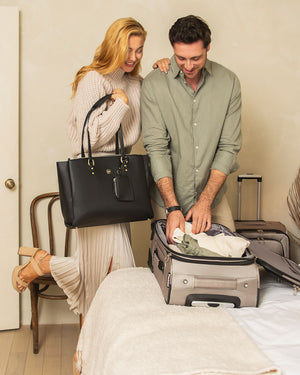


A personal item fits under the seat in front of you. A carry-on goes in the overhead bin. A checked bag goes in the cargo hold and you meet it again at baggage claim. That is the whole hierarchy, and every airline rule about luggage is a variation on those three positions.
What the hierarchy does not tell you is which combination to own, because the real difference is not size. It is where the bag is when you need it, what it costs to bring, and how much attention it takes between the curb and the hotel.
The size limits, by airline
As of May 2026. Please confirm with your carrier before your trip.
|
|
Personal item |
Carry-on |
Checked (standard) |
|
American |
18 x 14 x 8 in |
22 x 14 x 9 in |
62 linear in, 50 lb |
|
United |
17 x 10 x 9 in |
22 x 14 x 9 in |
62 linear in, 50 lb |
|
Delta |
Must fit under the seat, approx. 18 x 14 x 8 in |
22 x 14 x 9 in |
62 linear in, 50 lb |
|
Measured including |
Handles and straps |
Wheels and handles |
Wheels and handles |
|
Weight limit |
Rarely specified |
Often none on US domestic |
50 lb before overweight fees |
|
Where it rides |
Under the seat in front of you |
Overhead bin |
Cargo hold |
Three things worth knowing about this table. Carry-on dimensions are measured including wheels and handles, so a spinner spends part of its allowance on casters that hang below the shell. "Linear inches" means length plus width plus height added together, which is why a tall narrow bag and a short wide one can both be legal. And basic economy fares frequently allow only a personal item, whatever the standard carry-on rule says for that airline.
Policies shift by carrier, route, and fare, so check yours before you pack. The gate sizer is the only measurement that counts.
The personal item
The smallest bag, and the one people underrate most. It lives under the seat in front of you, which makes it the only bag you can reach mid-flight without standing up and apologizing to a row of strangers.
The job. Hold everything you need during the journey itself, plus everything you cannot afford to be separated from. Documents, medications, electronics, a layer, and enough to get through a day if your checked bag takes the scenic route.
The catch. Under-seat space varies by aircraft and by seat. A bag that slid under on the outbound flight can fight you on the return, and bulkhead and exit rows sometimes have no under-seat storage at all. Size to the smaller end of the rule, not the larger.
The pick. The Mini Weekender Tote Bag works as a personal item that does not look like one. It opens wide enough to find things without excavating, and it rides on a suitcase handle when you are carrying all three bags at once.
The strategic move with a personal item is to treat it as your insurance policy rather than your overflow. Overflow is what the other two bags are for.
The carry-on
The bag most travel arguments are actually about. It goes overhead, stays on the aircraft with you, and skips baggage claim entirely.
The job. Carry the trip. For most people a carry-on covers up to five days comfortably and a full week with some discipline, which makes it the single most useful bag category to own well.
The catch. Overhead space is finite and boarding order decides who gets it. On a full flight, late boarding groups get gate-checked, and the bag you packed for the cabin rides in the hold anyway. Pack it so a gate-check is an inconvenience, not a problem.
The pick. The Sion Reserve Carry-On Spinner handles the standard carry-on job: real interior organization, spinner wheels through the terminal, and sizing built to the common domestic allowance. Confirm against your airline before you fly.
The honest argument for carry-on travel is not that it is free, because it often is not. It is that your bag and your schedule stay attached to each other. A delayed connection reroutes both of you together.
The checked bag
The one you hand over at the counter and collect at the carousel. It buys you capacity and it buys you empty hands, and it charges you for both.
The job. Carry a week or more, or carry the awkward things: winter layers, several pairs of shoes, formalwear, gifts, gear. It also carries a second person’s clothes, which is the part people forget when they run the numbers on fees.
The catch. Time on both ends, a fee on most fares, and a window where the bag is somewhere you are not. The fix is to make that risk cheap: keep anything irreplaceable out of it.
The pick. The Ridge Large Checked Spinner is the size that changes the math for two travelers, because one large checked bag shared between two people costs one fee instead of two.
Run that against your airline’s fee schedule before you assume two carry-ons is the frugal option. On a week-long trip for two it frequently is not.
How many days fit in each?
Rough, and reliable enough to pack against:
|
Bag |
Comfortable |
Possible |
Pushing it |
|
Personal item only |
1 night |
2 nights |
A weekend, if you are ruthless |
|
Carry-on plus personal item |
5 days |
7 days |
10 days with laundry |
|
Checked plus personal item |
10 days |
2 weeks |
A month with laundry |
The reason those ranges stretch so far is that packing lists grow slower than itineraries. Tops scale with days. Bottoms, shoes, layers, and toiletries barely move. The full breakdown is in How to Pack for a 3, 5, or 7 Day Trip.
What goes where
This is the part that separates people who travel well from people who travel often. The three bags are not three sizes of the same container. They hold different categories of thing.
Personal item, always
• Passport, ID, boarding pass
• Prescription medications
• Wallet, cards, cash
• Laptop, tablet, phone, chargers
• Anything valuable or irreplaceable
• A change of clothes
• Glasses or contacts
• Whatever you need in the first 24 hours
Carry-on
• The clothing for the trip
• Toiletries within the liquid rules
• One alternate pair of shoes
• Anything you would rather not have crushed
Checked
• Bulk: layers, extra shoes, formal wear
• Full-size liquids
• Gifts and souvenirs
• Anything awkward, heavy, or genuinely replaceable
The rule underneath all of that: the further a bag gets from your hands, the more replaceable its contents should be.
The costs nobody puts in the comparison
Convenience versus space is the obvious frame. Here is what actually differs.
• Time. Checked bags can add extra time at both ends: a bag-drop line before security and a wait at baggage claim after you land.
• Attention. A carry-on comes with you through every line, restroom, and shop. It is a small tax on the whole journey that never makes the pros and cons list.
• Boarding position. Carry-on travel makes your boarding group matter. If you often board late, pay for position or plan for the gate-check.
• Fee asymmetry. Checked fees are known in advance. Carry-on costs show up as basic economy restrictions and gate-check charges, which are harder to budget for because they are conditional.
• Physical load. A carry-on gets lifted overhead in a narrow aisle with people waiting. A checked bag gets lifted twice: onto a scale and off a carousel.
None of these make one bag right. They explain why experienced travelers own all three and choose per trip.
Which combination should you actually own?
If you buy one bag: a carry-on. It covers the widest range of trips, it works as a checked bag when you need it to, and it is the only one of the three that can handle a whole trip alone.
If you buy two: a carry-on and a personal item that rides on it. That pairing covers everything from an overnight to a full week, and it is the setup that lets you skip baggage claim for most of the travel you actually do.
If you buy three: add a large checked bag rather than a medium one. The large is what makes two-people-one-fee possible, and it is the size you will not outgrow. A luggage set gets you there in one purchase with the sizes already matched.
Whichever way you go, SWISSGEAR luggage carries a 10-year limited warranty. Compare sizes across carry-on luggage, checked luggage, and travel accessories.
Still deciding between carrying on and checking for a specific trip? That one comes down to trip length and shoes: Comparing Carry-On vs. Checked Luggage.
FAQs
What is the difference between a carry-on and a personal item?
A personal item fits under the seat in front of you and stays reachable during the flight. A carry-on goes in the overhead bin and is larger, typically around 22 x 14 x 9 inches on major US carriers. Most standard fares allow one of each; basic economy fares often allow only the personal item.
Do wheels count toward carry-on size limits?
Yes. Airlines measure carry-on bags including wheels and handles, so a spinner spends part of its allowance on casters hanging below the shell. A bag with recessed inline wheels holds more inside the same external dimensions.
What does 62 linear inches mean for checked luggage?
Linear inches means length plus width plus height added together. A standard checked bag allowance on major US carriers is 62 linear inches and 50 pounds, so a tall narrow bag and a short wide one can both be legal as long as the three measurements sum to 62 or less.
How many days can you pack in a carry-on?
Five days comfortably, seven with disciplined packing, and up to ten if you have laundry access. Tops scale with the number of days, but bottoms, shoes, layers, and toiletries stay roughly fixed, which is why the range stretches further than people expect.
Is it cheaper to bring two carry-ons or share one checked bag?
For two people on a week-long trip, one large checked bag shared between them often costs less than two separate bags, and basic economy fares can charge for carry-ons as well. Check your specific airline and fare before assuming carrying on is the cheaper option.
What should never go in a checked bag?
Medications, travel documents, wallets, laptops and other electronics, jewelry, anything irreplaceable, and a change of clothes. The rule is that the further a bag travels from your hands, the more replaceable its contents should be.