


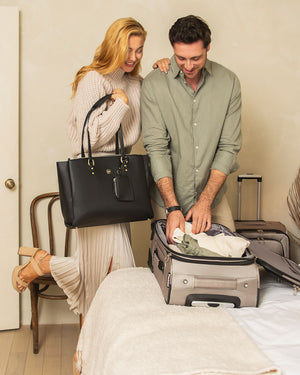


Pack one top per day plus a spare, one bottom for every 2 to 3 days, and a fixed base of layer, shoes, toiletries, and tech that does not grow with the trip. That puts a 3-day trip around 30 to 35 liters, a 5-day trip around 35 to 45, and a 7-day trip at 50 to 70. Which means: backpack or tote, then carry-on spinner, then checked spinner.
Most packing advice starts with a list. This one starts with a question: how many days are you gone?
That number decides almost everything else. How many shirts you need. Whether you skip the baggage counter. Whether your laundry strategy is "none" or "hotel sink." Trip length turns packing from guesswork into simple math, and once you know the math, the bag picks itself.
The packing math at a glance
|
Trip |
What you pack |
Volume |
Bag |
Typical bag fee |
|
3 days |
3 to 4 tops, 1 to 2 bottoms, 4 sets of underwear and socks |
30 to 35L |
Travel backpack or weekender tote |
Usually zero |
|
5 days |
5 to 6 tops, 2 to 3 bottoms, 6 sets |
35 to 45L |
Carry-on spinner plus a personal item |
Zero on most standard fares |
|
7 days |
7 to 8 tops, 3 bottoms, 8 sets |
50 to 70L |
Medium checked for one, large checked for two |
One checked fee, known in advance |
How much clothing do you actually need?
A reliable baseline for a trip of any length:
• One top per day, plus one spare
• One bottom for every 2 to 3 days (pants and jeans rewear well; nobody's checking)
• Underwear and socks for every day, plus one extra set
• One layer (jacket, sweater, or hoodie) regardless of trip length
• Two pairs of shoes maximum: the ones on your feet and one alternate
• Sleepwear, toiletries, chargers, and medications as a fixed base that doesn't grow with the trip
Notice what that formula tells you. A 7-day trip does not require twice the clothing of a 3-day trip. Tops scale with days. Bottoms, shoes, layers, and toiletries barely move. Your packing list grows slower than your itinerary does, which is good news for your back and better news for your baggage fees.
One honest exception: event travel. A wedding, a formal conference, or a ski trip adds bulky or delicate items that break the formula. If that describes your trip, size up one bag category from the recommendations here and keep the garment bag or gear separate. For everyone else, the math holds.
Packing for a 3-day trip
The load: 3 to 4 tops, 1 to 2 bottoms, 4 sets of underwear and socks, one layer, one alternate pair of shoes, toiletries, and tech. Rolled and packed with any intention at all, this fits in 30 to 35 liters.
That is personal item and small carry-on territory, which means a 3-day trip is your chance to fly with zero checked bags and, on many fares, zero bag fees. You walk past the carousel. You board without eyeing the overhead bins. This is the lightest version of travel, and it is worth protecting.
Want your hands free? A travel backpack like the Voyager handles a long weekend of clothing alongside a padded laptop compartment. Organizer pockets keep chargers, documents, and headphones from migrating to the bottom of the bag, which matters more than you would think when you are digging for a boarding pass in line.
Prefer a bag that opens wide and packs flat? The Weekender Travel Tote earns its name. It works solo for the 3-day trip and doubles as your personal item on longer ones, and the trolley sleeve slides over a suitcase handle so it rides along instead of hanging off your shoulder.
Either way, the strategy holds: for 3 days, one bag, no waiting, no fees.
Packing for a 5-day trip
The load: 5 to 6 tops, 2 to 3 bottoms, 6 sets of underwear and socks, one layer, one alternate pair of shoes, plus the fixed base. You are now in the 35 to 45 liter range, which is exactly what a standard carry-on suitcase holds.
Five days is the sweet spot of travel packing. Long enough that a backpack alone starts to feel tight, short enough that checking a bag stays optional. A carry-on spinner splits the difference: real capacity, real organization, and it still comes with you into the cabin.
The Sion Reserve Carry-On Spinner handles exactly this trip. It rolls upright beside you through the terminal instead of dragging behind, and it meets standard carry-on sizing for most major carriers, so it rides in the cabin rather than the hold. Confirm your airline before you fly, because allowances vary by carrier and fare.
A few tactics that make 5 days in a carry-on comfortable instead of tight:
• Roll your clothes. Rolling compresses better than folding and makes it easier to see what you packed.
• Wear the bulk. Your heaviest shoes and your one layer travel on your body, not in the bag.
• Use your personal item well. Pairing the carry-on with the Weekender Travel Tote on its trolley sleeve gives you a laptop station, an in-flight kit, and overflow room without adding a checked bag.
• Add packing cubes if you want categories to stay categories for the whole trip.
• Keep toiletries TSA-friendly. Containers of 3.4 ounces or less in one quart-size bag, and security stays a formality instead of a delay.
Do all that, and 5 days move through an airport as easily as 3.
Packing for a 7-day trip
The load: 7 to 8 tops, 3 bottoms, 8 sets of underwear and socks, one layer (maybe two, depending on climate), one alternate pair of shoes, and the fixed base. You are pushing 50 to 70 liters, and here you hit the week-long traveler’s fork in the road.
Path one: stay carry-on and do laundry
If your accommodation has a washer, or you will hand-wash a few items midweek, pack for 4 to 5 days and reset. It works. It also turns one evening of your vacation into laundry night.
Path two: check a bag and pack the whole week
For most 7-day travelers, especially families and anyone with an itinerary too full for chores, this is the honest answer. A medium checked spinner becomes the right tool rather than an indulgence. The Energie Medium Checked Spinner covers a full week for one traveler with room to organize rather than compress, and the expansion depth is your return-trip insurance policy for whatever the destination talks you into.
Traveling as a pair or a family, or heading somewhere that demands serious wardrobe range? Size up to the Ridge Large Checked Spinner. A large checked bag lets two travelers consolidate into one checked fee instead of two, which is often the single biggest baggage savings available on a week-long trip. Run that against your airline’s fee schedule before you assume two carry-ons is the frugal play. It frequently is not.
One tip for any checked bag: keep a change of clothes, medications, and anything you cannot replace in 24 hours in your personal item. Checked luggage is dependable. Airlines, occasionally, are not.
The budget angle
Most airlines charge for checked bags, and some charge for carry-ons, so your bag choice is a line item in the trip budget. The framework is simple:
• 3 days: one personal item or small carry-on. Fees usually zero.
• 5 days: one carry-on plus a personal item. Fees zero on most standard fares, modest on basic economy.
• 7 days: one checked bag per traveler, or one large checked bag shared between two. Fees known in advance, and often cheaper than the overweight surprise at the counter.
Weigh your packed bag at home before a checked-bag trip. A bathroom scale and 30 seconds can save you an overweight fee that costs more than checking the bag did.

The short version
Pack tops by the day, bottoms by the half-week, and everything else as a fixed base. Then let the trip length pick the bag:
• 3 days: a travel backpack or weekender tote, carried on, no fees
• 5 days: a carry-on spinner, ideally paired with a tote that rides on top
• 7 days: a medium checked spinner for one, a large checked spinner for two
Life is always in motion. The right bag keeps your things moving with it. Shop suitcases and travel bags to build the setup that fits how you travel. Luggage carries a 10-year limited warranty; backpacks, totes, and bags carry 5-year limited.
Packing the backpack itself? Start with How to Pack a Backpack That Works All Day.